

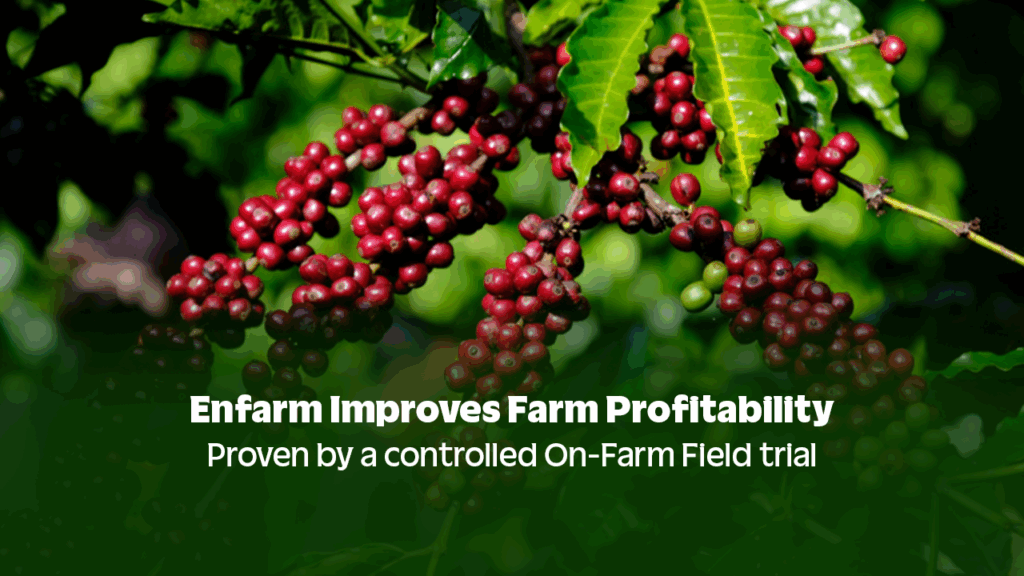
A 12-month controlled trial in Dak Lak shows that when soil nutrition is monitored on-site and precisely managed with AI, farmers can apply less fertilizer while achieving higher yields.
1/ Same farm, two approaches
At Mr. Pham Ngoc Son’s coffee farm in Dak Lak, Enfarm implemented a controlled experiment from December 2024 to December 2025 to evaluate the effectiveness of its technology under real farming conditions. The study was designed as a side-by-side comparison: two plots within the same farm, sharing identical soil conditions and overall management practices, with the key difference being the fertilization approach. The experimental plot covered 3,000 m² with 305 trees, while the control plot also covered 3,000 m² with 410 trees.
In this model, the Enfarm experimental plot was equipped with Enfarm F+ to monitor seven key parameters: N, P, K, pH, soil moisture, temperature, and EC, while receiving AI-driven nutrient recommendations via the Enfarm app. The control plot followed the farmer’s conventional fertilization practices.
2/ Why use “tree-equivalent” comparison?
A critical scientific consideration is that the two plots did not share the same age structure. The experimental plot had 15.7% young trees (0–2 years old), while the control plot consisted mostly of mature trees. Therefore, instead of comparing total yield directly, the study normalized results using “tree-equivalent” units to ensure fairness. After normalization, the experimental plot had 272.5 tree-equivalents, while the control plot had 404.5.
In short: looking only at total yield could lead to misleading conclusions. Only by standardizing biological conditions can the true impact of the fertilization strategy be assessed.
3/ Key results: less input, higher normalized yield
The results show that the Enfarm plot incurred 13,798,024 VND in fertilizer costs over 3,000 m², compared to 16,600,000 VND in the control plot—equivalent to a 17% cost reduction. At the same time, after normalization, fresh cherry yield in the Enfarm plot reached 8.45 kg per tree-equivalent, compared to 7.42 kg in the control plot, representing a 19% increase.
In other words, better results did not come from applying more fertilizer, but from applying it more precisely.
Beyond higher yield: improved bean quality
Compared to the control plot, the Enfarm plot recorded:
- Fruiting branches increased by 33%
- Fruits per node increased by 23%
- Total fruits per branch increased by 19%
- Fruit size increased by 37.5%
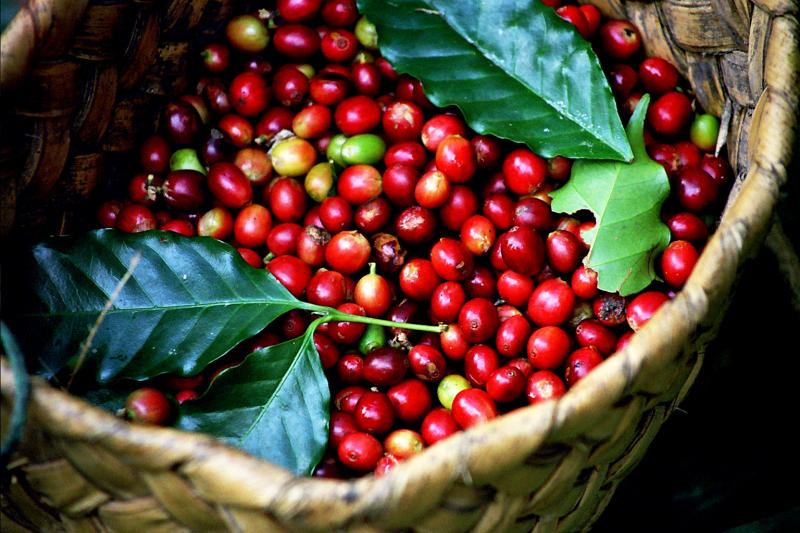
At the bean level, the difference was even more significant. The average bean weight in the experimental plot reached 0.331 g, compared to 0.200 g in the control plot, an increase of 65.5%. Bean diameter also increased by 17.9%. The report highlights these as economically significant indicators, as they directly impact bean grading and market price.
4/ What drives the difference?
In the control plot, fertilization mainly focused on nitrogen and phosphorus, with no foliar micronutrient application. In contrast, the Enfarm plot applied a more balanced nutrition strategy, combining N–P–K–Ca–Mg and micronutrients tailored to each growth stage. The report shows that nitrogen use in the control plot was 5.8 times higher than in the experimental plot, while the Enfarm plot maintained better balance in calcium and magnesium—key factors for bean quality and reducing fruit drop.
This highlights an important insight: in agriculture, efficiency does not always come from increasing inputs. Often, it comes from reducing decision errors in fertilization.
5/ Economic impact: how much more do farmers earn?
Based on normalized yield, the experimental plot achieved 2.09 kg of green coffee beans per tree-equivalent, compared to 1.85 kg in the control plot. When scaled to a standard density of 1,100 trees per hectare, the additional yield is estimated at approximately 264 kg of green beans per hectare.
At the actual selling price recorded at the farm—132,000 VND/kg—this translates to an additional revenue of approximately 34,848,000 VND/ha. Combined with fertilizer cost savings of about 9,412,552 VND/ha, the total direct economic benefit is estimated at around 44,260,552 VND/ha.
These results reflect two core factors validated by the trial: increased production value and optimized input costs. It should be noted that this figure represents direct economic gains only and does not include other production costs such as labor and crop protection.
6/ How should these results be interpreted?
The report also notes that the current results do not fully reflect the model’s potential. The experimental plot still includes mixed varieties, a relatively high proportion of young trees, and intercropping factors. This suggests that under more uniform conditions, the effectiveness could be even more pronounced.
It should also be clarified that the previously mentioned figure of 12.22 million VND represents an earlier estimate of direct economic gain based on measured variables of increased yield and reduced fertilizer cost. This is not a full net profit calculation, as labor and crop protection costs were not included due to equivalent management across both plots.
7/ From one farm to a new approach
The most valuable takeaway is not just the figures of 17% or 19%. It is the clear direction this model demonstrates: when farmers have access to on-site nutritional data and AI-driven recommendations tailored to each growth stage, fertilization decisions no longer rely primarily on intuition. They become more precise, more efficient, and economically more valuable.
According to the report, this serves as real-field evidence that Enfarm’s nutrient management technology can reduce fertilizer use while increasing crop productivity.
For Enfarm, this is more than a successful trial. It is proof that when technology is designed correctly for real farming conditions, it can directly translate into higher income for farmers.