

In Đắk Phơi commune (Đắk Lắk), as part of a project focused on developing agroforestry models combined with community-based tourism, Enfarm contributes by providing soil monitoring and data analysis solutions, enabling more precise and sustainable farming practices.
The project aims to build a diversified livelihood system that integrates agricultural production, circular agroforestry, and community tourism. This approach helps improve local incomes while enhancing resilience to climate change.
One of the key activities is training on biochar. Following the program, farmers’ understanding increased from 16% to 60%, and 80% of participants committed to applying biochar in their production practices. Awareness of agricultural by-product management also improved significantly, with an estimated 22% reduction in open burning. Biochar has initially shown potential in improving soil quality, enhancing moisture and nutrient retention, and reducing reliance on chemical fertilizers. Indicators such as fertilizer reduction and yield improvement are still being monitored.
In addition, the project has supported the provision of 6,000 kg of organic fertilizers, along with other inputs for production and livelihoods, contributing to a stronger foundation for local economic development.
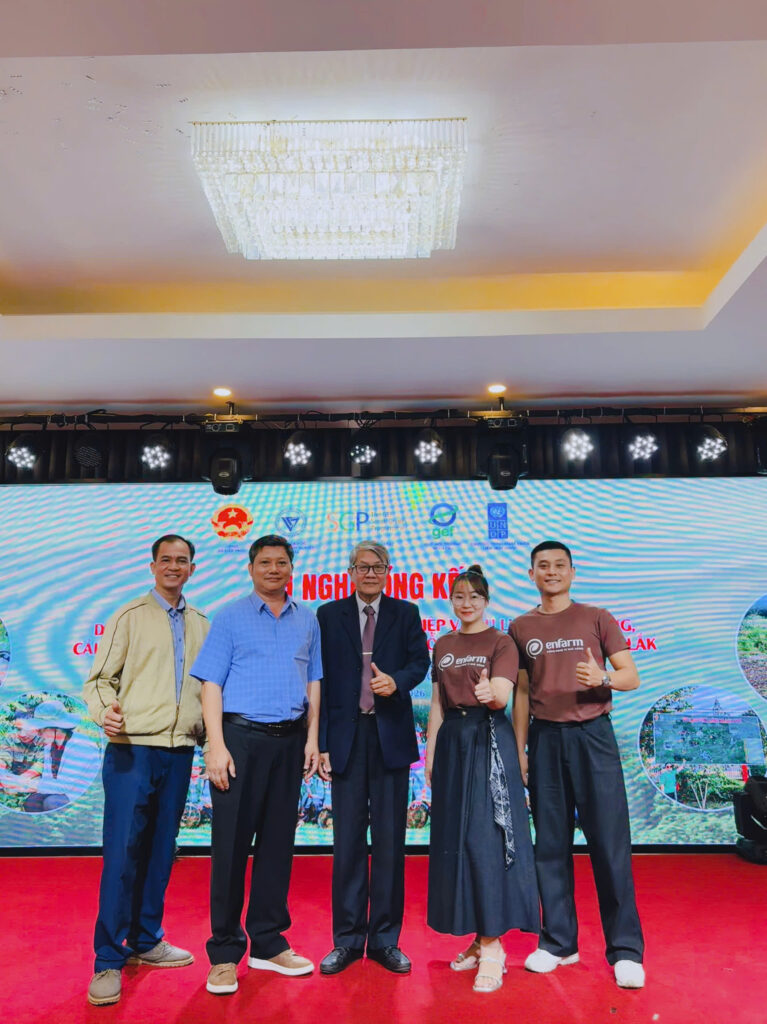
Enfarm’s Role in the Project
In the initial phase, Enfarm deployed five sets of soil sensors and monitoring devices across representative farming areas, serving multiple households.
Installed directly in the fields, the devices continuously collect soil data and display it on mobile devices, enabling farmers to:
- Monitor soil conditions over time
- Adjust fertilization and crop care practices more effectively
- Gradually transition from experience-based to data-driven farming
The data collected not only supports decision-making for each crop cycle but also serves as a foundation for evaluating the effectiveness of biochar under real farming conditions.
For Enfarm, this implementation goes beyond technology deployment. It is an opportunity to gain deeper insights into how the soil–plant–human system operates within specific local contexts. These insights allow Enfarm to continuously refine its solutions to better meet farmers’ needs—making them more practical, accessible, and adaptable to real-world farming conditions.