


Every year—immediately following the harvest—the Enfarm team returns to customers’ orchards for a critical routine: we listen, we measure, and we compare. We do it to answer the only question that matters to our customers and our business model:
Did data make farming more predictable—and more profitable per kilogram of fruit?
This season, we conducted a snapshot survey of 20 durian orchards (7 confirmed Enfarm users and 13 non-users). To ensure data integrity and reduce distortion from outliers, we report medians, not averages. Here is what the data tells us about the impact of the Enfarm soil nutrient sensing technologies.
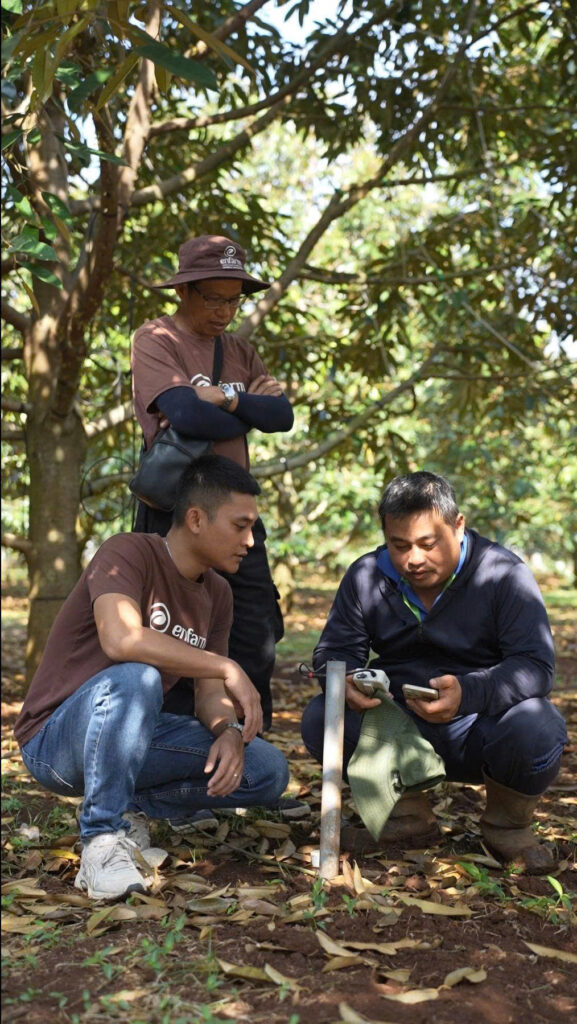
The Macro View: Outperforming the National Benchmark
To understand the value of Enfarm, we first established a baseline using data from the Department of Crop Production (Ministry of Agriculture ̃ Environment).
- National Yield Reference: ~15.8 tons/ha (implied average).
- Enfarm User Median: ~21.4 tons/ha / Enfarm User Average: ~23.2 tons/ha
In this season’s snapshot, the median enfarm orchard performed roughly +36% while the average enfarm one performed +47% above the national reference. Furthermore, 5 out of the 7 Enfarm orchards surveyed performed at or above this benchmark.
The Core Metric: Efficiency and Unit Economics
Yield matters, but efficiency is what drives margins. The true test of ag-tech is whether it lowers the input cost required to generate that yield.
Our survey revealed that Enfarm users are not just growing more; they are converting inputs into revenue more effectively.
- Fertiliser Efficiency: ~12.5 kg of fruit produced for every 1 kg of fertiliser applied.
- Fertiliser Cost per Kg of Fruit: ~VND 1,580.
The Insight: Enfarm users did not always apply less total fertiliser per hectare than their peers. Instead, the data indicates a strong “conversion signal.” By using NPK sensors to apply nutrients only when the tree could actually absorb them, they optimized the cost of every kilogram of fruit produced.
Crucially, this efficiency serves a larger purpose. According to the FAO, global food production must increase by 70% by 2050 to meet human demand. By maximizing the output per kilogram of fertilizer, Enfarm helps bridge this gap on existing farmland—reducing the pressure to clear forests for agricultural expansion and curbing the emissions associated with inefficient input use.
From Habit to Evidence: User Behavior Shifts
Technology is only as good as the decisions it enables. Below are three examples of how real-time soil data shifted user behavior from “routine” to “reasoning.”
The “Capital Efficiency” Shift: Managing 80 hectares means every decision is multiplied by thousands of trees. For Mr. Hà Văn in Cư M’gar (Daklak), the standard “routine” during the second flush called for 700g of fertiliser per tree. However, his Enfarm sensors flagged a crucial insight: the soil was already retaining significant Nitrogen.
He trusted the data, dialing the application down to 400g—a 40% reduction. Across his operation, that single decision saved 3–4 tonnes of fertiliser in one round. He achieved the same growth while significantly improving his working capital.
The “Scalability” Shift: For Mr. Thành in Quang Phu (Daklak), farming had historically been a defensive game, with yields hovering around a respectable 20 tons/ha. Real-time soil visibility allowed him to switch to offense.
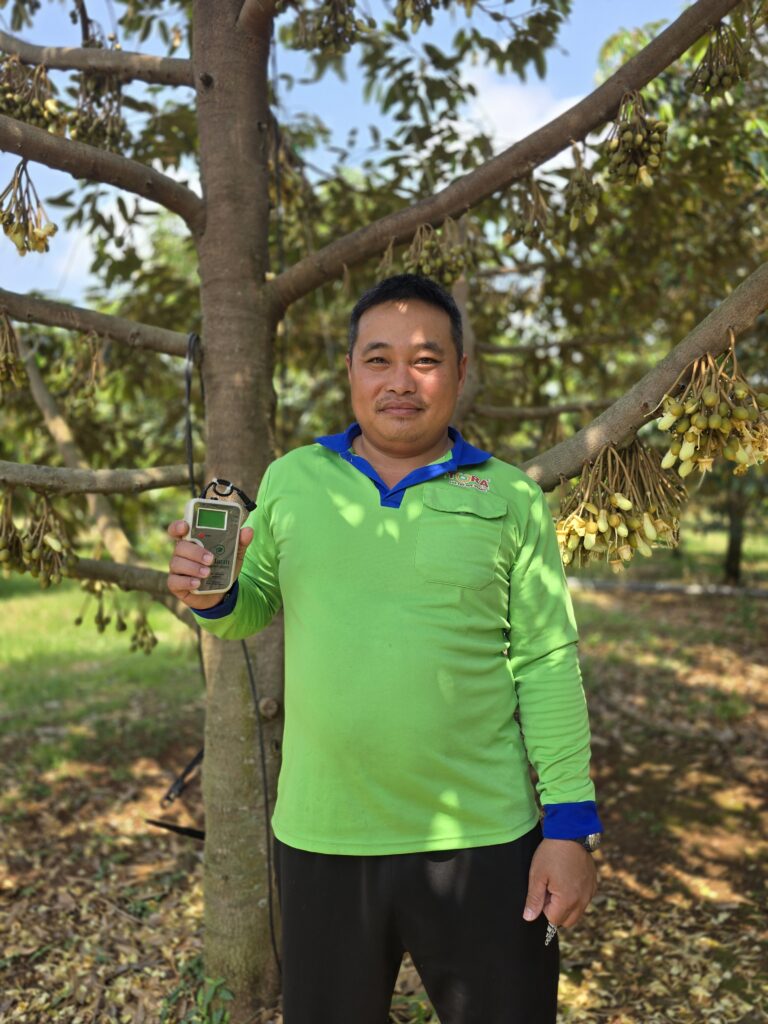
With clear data on soil health, he stopped guessing and set an aggressive new target: 30 tons/ha. He didn’t just hope for it; he hit it. His season demonstrates a fundamental truth for investors: when risk is visible, scalability becomes possible.
The “Risk Mitigation” Shift: In Dak Mi (Lam Dong), Mr. Sơn was managing his orchard as a single uniform unit—until the data revealed he was actually farming two. Enfarm sensors detected two distinct soil profiles within his boundary, each with vastly different moisture retention rates.
By treating them as the same, he had been unknowingly over-watering the retentive soil, inviting expensive problems like trunk cracking and gummosis. The shift to zone-specific management didn’t just save water; it protected the long-term asset value of his trees from preventable disease.
Controlled Validation: The Demo Orchard
While field surveys reflect real-world variance, our controlled demonstration orchard in Cư Quìn isolates the variables for rigorous A/B testing.
Year 2 Results (Enfarm Block vs. Control Block):
| Metric | Impact |
| Fertiliser Cost | 83% of Control (17% Savings) |
| Yield Volume | 119% of Control (19% Increase) |
Note: In previous trials at this site, we achieved a ~30% yield increase while using 40% less Nitrogen and 30% less Potassium, proving that we can decouple yield growth from input costs.
Conclusion: The Data Verdict
This season’s survey delivers a clear affirmation: Enfarm’s technology is not just a monitoring tool; it is a profitability engine.
By outperforming the national yield benchmark by 36% and driving superior fertiliser efficiency, our users have proven that precision agriculture is no longer a luxury—it is a competitive necessity.
We are decoupling yield growth from excessive input costs, directly addressing the FAO’s 2050 challenge to produce more food without expanding our footprint. For the farmer, this means higher margins and lower risk.
The era of guessing is over. The era of precision has arrived.